

Key Takeaways
- Gate and check valves serve fundamentally different roles in industrial fluid systems, making correct selection critical to safety, reliability, and performance.
- Gate valve vs check valve decisions should be based on control intent versus protection needs, not interchangeability.
- Gate valves support deliberate isolation, making them essential in pump-driven and pressurised systems.
- Check valves respond automatically to flow reversal and transient conditions, reducing pressure-related stress and equipment damage.
- Using these valves together in specific configurations improves system resilience, combining operational flexibility with automatic protection.
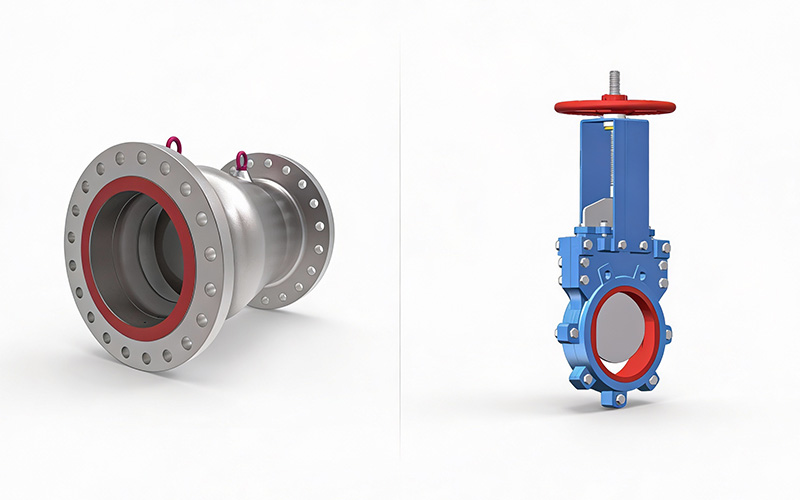
Gate and check valves are both widely used in industrial fluid piping systems, but they differ in terms of function, operation, and application. This article provides a detailed gate valve vs check valve comparison, examining how each component controls flow, responds to pressure changes, and fits into different system configurations.
What Are Gate Valves and Check Valves?
A gate valve is a manually operated valve used primarily for flow isolation. It controls flow by raising or lowering a solid gate perpendicular to the flow path. When fully open, it provides a straight-through passage with minimal pressure loss, making it suitable for applications where unobstructed flow and positive shut-off are required.
A check valve is an automatic valve designed to prevent reverse flow. It opens under forward flow conditions and closes when flow slows or reverses, protecting upstream equipment from backflow-related damage. Different types of check valves are available to suit varying pressure, flow, and installation requirements. For example, swing-check valves use a hinged disc that responds quickly to changes in flow direction, making them common in pump discharge applications.
The Key Gate Valve vs Check Valve Difference: Control vs Automatic Protection
The primary distinction in gate valve vs check valve selection lies in how each valve manages system control and protection.
Gate valves are designed for deliberate, operator-controlled actions. They are used when flow must be intentionally started, stopped, or isolated, such as during planned shutdowns, sectional pipe isolation, or commissioning activities. Their operation depends on manual or mechanical actuation, making them suitable for predictable operating conditions where response time is not critical.
Check valves serve a fundamentally different purpose. They provide automatic protection by responding directly to changes in flow direction and pressure. When forward flow is interrupted or reverses due to events such as pump trips, pressure imbalance, or sudden stoppage, the check valve closes immediately without requiring operator input. This pressure-driven response helps reduce the effects of sudden flow reversal and pressure transients without relying on operator intervention.
Combining Gate Valves and Check Valves in Fluid Systems
In many industrial systems, gate valves and check valves are used together to provide both operational control and automatic protection.
Typical Configuration
A common arrangement places the check valve closest to the pump, with a gate valve installed downstream. This allows rapid response to flow reversal while enabling operators to isolate the line for inspection or maintenance without draining the entire pipeline.
Placing the isolation valve downstream also reduces the risk of operational damage. If the gate valve is closed inadvertently, this configuration limits stress on the check valve, supporting longer service life and more stable system performance.
Flexible Adjustments for Specific Operating Conditions
Although placing the check valve upstream of the gate valve is common practice, real-world operating conditions may require different sequencing. Examples include:
1. High-Pressure or High-Temperature Services
In steam or thermal systems, gate valves may be positioned upstream to withstand initial pressure and temperature exposure, helping to protect downstream components from excessive mechanical stress.
2. Parallel Pump or Multi-Pump Header Systems
Each pump outlet is often fitted with its own gate valve so that individual pumps or check valves can be isolated for maintenance without causing reverse flow through adjacent lines.
3. Restricted or Compact Installations
In offshore modules, marine engine rooms, or tightly packed skids, valve placement may be adjusted to suit space constraints. Any deviation from standard layouts should be supported by hydraulic modelling and analysis to confirm acceptable pressure behaviour and system safety.
The Critical Importance of Correct Valve Selection
A clear understanding of gate valve vs check valve differences is essential for maintaining reliable and safe fluid systems. Gate valves provide deliberate isolation and operational control, while check valves deliver automatic protection against reverse flow and pressure-related damage. When specified correctly and used together where appropriate, they help reduce equipment stress, minimise operational risk, and support long-term system stability in demanding industrial environments.
Working with experienced check and gate valve suppliers enables project teams to translate these technical considerations into practical, application-appropriate valve solutions. At OTOM Services Pte Ltd, we offer accurate specification, dependable sourcing, and post-sales support for critical flow control components across various sectors.
Contact us today.
Related Articles
Common Symptoms of Check Valve Failure to Look Out For
Check valve failure can introduce risks that extend beyond the valve itself, affecting equipment integrity and system stability. This article outlines key symptoms that signal declining performance and explains their underlying causes. With a clearer understanding of how these issues develop, engineers and maintenance teams can intervene earlier to safeguard assets and maintain reliable system operation.
Exploring the Impact of Globe Valve Size on Flow Efficiency and Pressure Drop
Choosing the right globe valve size is critical to maintaining efficient flow and stable pressure. This article explains how flow regulation principles, pressure limits, and fluid properties influence sizing decisions, helping operators understand why correct selection improves control, protects equipment, and supports long term system reliability across industrial and marine applications. Read on to find out more.